cHECK OUT OUR NEW STORY "tHE ALPHEA CHAMPION"!
What is the inspiration for Odaria?
A look at where we are drawing inspiration from and how we are applying it in the game.
Judah Foster
5/5/20266 min read
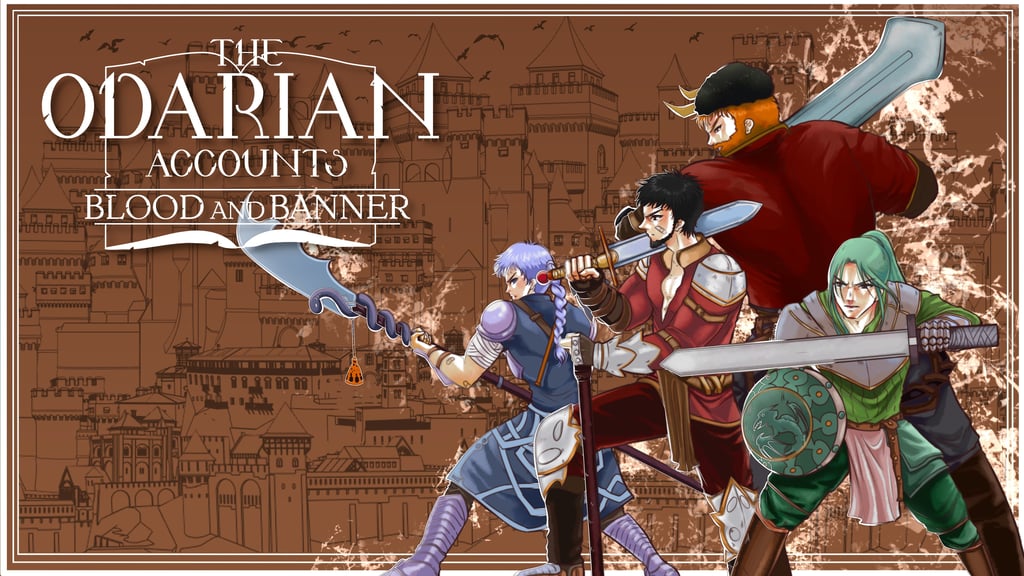
Inspirations Behind The Odarian Accounts: Blood and Banner
Every game starts somewhere. Sometimes it begins with a mechanic. Sometimes with a character. Sometimes with a feeling you can’t quite put into words, so you spend months trying to build an entire world around it until it finally makes sense.
For The Odarian Accounts: Blood and Banner, we didn’t start with just one source of inspiration. We started with several—each pulling the project in a different direction, like opposing winds shaping the same storm.
And instead of choosing one over the other, we decided to do something a little more ambitious (and slightly reckless):
We’re blending them.
At the heart of our design philosophy are three major inspirations:
The gameplay fluidity and emotional combat of Kingdom Hearts
The dungeon design, exploration, and puzzle structure of The Legend of Zelda
The political complexity, tone, and brutal realism of Game of Thrones
Individually, these influences are powerful. Together, they form something we hope feels familiar yet unpredictable—like remembering a dream that clearly belonged to someone else.
Let’s break down how each one shapes The Odarian Accounts: Blood and Banner.
Kingdom Hearts: Combat as Emotion, Not Just Mechanics
Let’s start with the obvious influence in gameplay flow and combat philosophy: Kingdom Hearts.
Say what you want about the series, but one thing is undeniable—it made combat feel expressive.
In Kingdom Hearts, fighting isn’t just about stats or timing. It’s about momentum, movement, and emotional rhythm. Battles feel like choreography. Even when things get chaotic (and they often do), there’s a sense that you are inside something stylized and intentional.
That’s exactly what we want to capture in The Odarian Accounts: Blood and Banner.
But we’re not just copying mechanics. We’re taking inspiration from the feeling of combat.
Combat as Expression
In Odaria, combat is designed to reflect the emotional and narrative state of the player and the world around them.
Instead of purely static skill trees or rigid systems, abilities evolve based on:
Player decisions
Allegiances
Interpretations of historical events
Relationships with factions and characters
This means combat isn’t just “build optimization.” It’s identity expression.
Two players might face the same enemy, but fight in entirely different ways—not because of gear alone, but because of how they understand the world.
One player might fight aggressively, embodying a faction that values conquest.
Another might fight defensively, shaped by a worldview that prioritizes survival and preservation of knowledge.
The result is combat that feels less like solving a math problem and more like telling a story with movement.
Fluidity Over Rigidity
We also take inspiration from the fluid transitions in Kingdom Hearts—the way exploration, dialogue, and combat often blend into one continuous experience.
In Odarian Accounts, we want to avoid hard separation between “story mode” and “combat mode.” Instead, we aim for a world where:
Conversations can shift into tension
Exploration can evolve into conflict
And battles can end with narrative consequences, not just loot screens
The world doesn’t pause when gameplay shifts. It reacts.
Because in Odaria, nothing is ever truly separate from history.
Zelda: Dungeons as Language, Not Just Layouts
If Kingdom Hearts gives us emotional motion, then The Legend of Zelda gives us structure.
Specifically: dungeons.
But not just dungeons as “levels.” Dungeons as storytelling devices.
Every Dungeon Tells a Story Without Words
One of the most inspiring things about Zelda is how its dungeons communicate meaning without needing constant dialogue. You enter a space, and immediately:
The architecture tells you what kind of culture built it
The puzzles reflect the logic of the environment
The enemies hint at what once happened there
We want to bring that philosophy into The Odarian Accounts: Blood and Banner.
Every major location—whether it’s a ruined fortress, an abandoned archive, or a politically contested cathedral—will function like a narrative dungeon.
Dungeons as Historical Echoes
In Odaria, dungeons are not just places. They are consequences.
A collapsed royal archive isn’t just a setting—it’s a statement about censorship, lost knowledge, and deliberate erasure.
A militarized border fortress isn’t just an obstacle—it’s a reflection of decades of escalating mistrust between factions.
Players will not just solve puzzles in these spaces. They will interpret them.
Why is this mechanism here?
Why does this path open and that one close?
Why does the environment feel like it is resisting you?
The answer is rarely just “game design.” It is history embedded in architecture.
Puzzle Design as Interpretation
We are also drawing inspiration from Zelda’s approach to puzzles: they are never arbitrary. They teach you how to think about the world.
In Odarian Accounts, puzzles will often tie into:
Historical contradictions
Fragmented records
Environmental storytelling that requires interpretation rather than brute force
Solving a dungeon is not just about progression. It is about understanding what the space means.
And sometimes, understanding it correctly changes how the world reacts afterward.
Game of Thrones: Politics, Power, and the Weight of Consequences
If Kingdom Hearts is emotion and Zelda is structure, then Game of Thrones is the backbone of tone, politics, and consequence.
And we do not say that lightly.
Because what Game of Thrones did exceptionally well—at least in its earlier narrative arcs—was treat politics as something messy, layered, and deeply human.
No one is purely good. No one is purely evil. Everyone is operating under pressure, fear, ambition, or survival.
That is exactly the kind of world Odaria is built to reflect.
Politics as a Living System
In The Odarian Accounts: Blood and Banner, politics is not background flavor. It is the engine of the world.
Factions are not static. Alliances shift. Treaties fracture. Historical interpretations influence current legitimacy.
And most importantly: information is power.
Because of the Odarian Accounts themselves—fragmented, contradictory historical records—political power often depends on which version of history people believe.
That means:
A faction might justify war based on a “historical betrayal” that another faction denies ever happened
Entire regions may operate under conflicting legal narratives
And players may unknowingly influence political stability simply by choosing which accounts to trust or preserve
Truth is not just philosophical in Odaria. It is structural.
Tone: Beauty, Brutality, and Everything In Between
We are also inspired by how Game of Thrones balances beauty and brutality.
One moment, you are watching a quiet political conversation in a candlelit hall. The next, you are witnessing the consequences of decisions made long before the scene began.
We want that same tonal layering in Odarian Accounts.
This means:
Emotional character moments exist alongside political tension
Quiet exploration can suddenly reveal large-scale consequences
And no victory is ever completely clean
But we are also careful not to simply replicate darkness for its own sake.
Odaria is not about hopelessness.
It is about complexity.
Even in collapse, people build meaning. Even in conflict, they preserve culture. Even in chaos, they try to record what happened—however imperfectly.
That tension is what gives the world weight.
Where These Inspirations Intersect
What makes The Odarian Accounts: Blood and Banner exciting for us is not just each inspiration individually—but how they collide.
From Kingdom Hearts, we take expressive, emotional combat.
From Zelda, we take environmental storytelling and puzzle-driven exploration.
From Game of Thrones, we take political depth and moral ambiguity.
But the magic happens in the overlap.
Imagine:
A dungeon that represents a historical political betrayal
A combat system that shifts depending on which version of that history you believe
A faction war that changes based on how you interpret environmental clues in ancient ruins
That is the kind of interconnected design we are aiming for.
Nothing exists in isolation. Everything is connected.
Even the past.
Especially the past.
The Risk of Mixing Influences (And Why We’re Doing It Anyway)
Blending inspirations like this is not simple. Each of these titles excels in its own domain. Trying to combine them risks losing what makes each one special.
But that is also where the opportunity lies.
We are not trying to clone any of these experiences.
We are asking a different question:
What happens when gameplay, exploration, and politics all speak the same language?
What happens when combat is emotional, dungeons are interpretive, and politics is inseparable from history?
The answer might be messy.
But it will be interesting.
And in game development, “interesting” is often the best place to start.
Final Thoughts
The Odarian Accounts: Blood and Banner is not built on a single inspiration. It is built on a conversation between inspirations.
Between fluid action and emotional storytelling.
Between structured exploration and environmental meaning.
Between political realism and myth-making.
Each influence brings something essential to the table. And together, they form the foundation of a world where nothing is simple, everything is layered, and every choice echoes further than you expect.
We are still early in development. There is still a long road ahead, full of iteration, refinement, and probably at least a few existential crises about dungeon design.
But the direction is clear.
We are building something that sits at the intersection of these ideas.
Something familiar.
Something strange.
Something that remembers more than it tells you.
And something that, we hope, feels alive in a way that stays with you long after you put the controller down.
contact us
stay connected
contact@foster-games.com
© 2025. All rights reserved.
Additional LINKS
Presskits